
Practice area
Private AI
Open-weight language models running on hardware you control, answering questions against documents you own. Nothing is sent to a third-party service, because there is no third-party service in the path.
The problem with the default
Most AI adoption is a data-export decision made by accident
The convenient way to use AI is to paste your information into somebody else's service. That is fine until the information is a contract, a client record, a security architecture diagram, or anything covered by an obligation you signed. At that point the same convenience becomes a disclosure you have to explain.
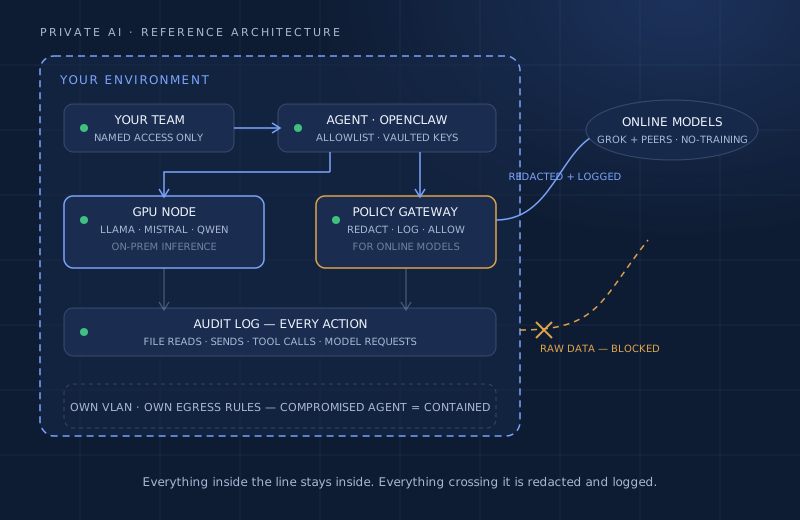
A private deployment inverts the arrangement. The model runs on your infrastructure — a GPU host in your server room, or a rack in our data center. Your documents are indexed locally. Queries are answered locally. There is no outside account holding your data, no vendor training on your content, and no terms of service standing between you and your own information.
It is not a smaller version of a hosted service. Open-weight models are genuinely capable at summarization, drafting, search, extraction, and question-answering over a document set — which is where most business value actually sits.
What we build
From hardware to a tool your team actually uses
Hardware sizing
We work out what model class your workload needs and what GPU, memory, and storage that implies — then design the host around it, rather than selling you capacity you will never use.
Local model serving
Open-weight models served on your infrastructure, with the ability to run more than one so different teams get a model suited to their task.
Document retrieval
Your files indexed locally so answers are grounded in your actual documents, with citations back to the source — which is what makes the output usable rather than plausible.
Access control
Uses your existing identity provider. People see the document sets they are already entitled to see, and nothing else — the retrieval layer respects your permissions.
Logging and oversight
Prompts and responses recorded locally for audit and quality review, retained on your schedule, stored on your hardware.
Team enablement
Prompt patterns and workflows for the specific work you want to move — drafting, review, triage, research — plus honest guidance on where the model should not be trusted.
Straight answers
What private AI is not
AI is a subject where expectations outrun reality. These are the limits we state up front, because a deployment that promises the wrong thing fails slowly and expensively.
It will not replace judgment
Models summarize, draft, extract, and retrieve. They also state wrong things with complete confidence. Every workflow we build keeps a human in the loop for anything that matters.
Privacy has a hardware cost
Running models locally means buying and powering GPUs. For heavy, constant use that is often cheaper than per-token pricing; for occasional use it usually is not, and we will say so.
You can see what it is doing
Which model, which documents, which prompts, what was logged — all visible and documented. Nothing about the deployment is hidden from you or from your auditor.
Questions
Private AI, answered
Where does the hardware live?
Wherever suits you. A GPU host in your own server room or network closet is common and keeps everything physically on site. If you would rather not run and cool it yourself, a rack in our data center gives you the same private boundary with professional power, cooling, and physical security — and it is on the same network design we already manage.
Does any data leave our premises?
In the design we deploy, no — not for inference and not for indexing. The model weights come to you; your documents stay where they are. One caveat we will always state plainly: model updates, and any optional features you ask us to connect to an outside service, involve a transfer. Those are choices you make explicitly, not defaults buried in a deployment.
What kind of hardware does this need?
It depends on the model class and the volume of documents being searched. A useful internal assistant is achievable on a single modern GPU host; larger models and heavier concurrent use need more. We size it from your actual workload during the assessment rather than guessing, and we will tell you if your use case does not justify the hardware.
Which models do you use?
Open-weight models, chosen per task, and documented in your deployment so you always know what is answering and under what license. Part of the point of a private deployment is that the model is a component you can replace — moving to a newer or better model later is a change to your hardware, not a renegotiation with a vendor who owns your workflow.
How does this affect our SOC 2 or compliance position?
Handled deliberately, private AI is easier to defend than the alternative, because there is no third-party processor holding your data and no new subprocessor to disclose. It does introduce new controls to document — who can query what, how prompts are logged, how the model host is hardened and patched. We document those as part of the deployment, which is far less work than retrofitting them later.
Can we start small?
Yes, and we recommend it. A single host with one well-chosen model, aimed at one real workflow, tells you more in a month than a large deployment tells you in a quarter. If it earns its place, scaling up is adding hardware to a design that already works.
Keep your data, and still use modern AI
Tell us the workflow you want to improve. We will tell you what it takes — hardware, model, and cost — before you commit to anything.